



Mobile health clinics (MHCs) are more than community care resources; they can also be dynamic, real-world “classrooms on wheels” that prepare the next generation of healthcare professionals. By immersing students in hands-on experience, interprofessional collaboration, culturally responsive care, and high-fidelity simulation, MHCs bridge the gap between academic theory and practical community-based care, benefiting students from community colleges, nursing colleges, and universities.
MHCs are uniquely suited to position students to develop essential clinical and professional competencies in real-world community settings, whether in functioning as a medical clinic in the field or in a mobile simulation lab.
Each level of higher education is influenced by the MHC ecosystem, benefiting students at various stages of their career pathways.
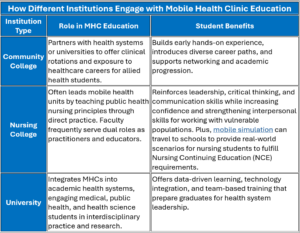
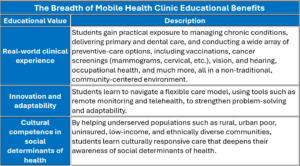
Mobile Medical Clinics provide significant benefits to future healthcare professionals by providing direct, hands-on experience, exposing learners to chronic disease management, preventive screenings, and the complexities of serving diverse communities. And mobile simulation labs offer a practical, hands-on way for nurses, paramedics, and other healthcare professionals to fulfill continuing education (CE) requirements needed to maintain licensure while staying current with best practices.
Beyond their educational value, mobile clinics also strengthen community health by reducing access barriers, promoting early intervention, and empowering patients to take charge of their well-being. The result is a win–win: healthier communities and providers entering the workforce better equipped and more confident.
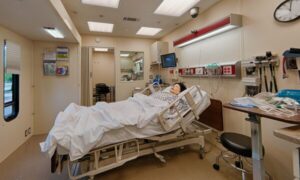
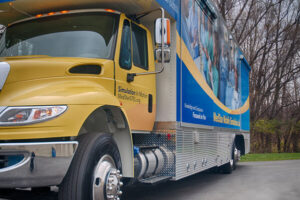
Mobile simulation labs are unique in transforming how colleges, universities, and training programs prepare the next generation of healthcare professionals. By pairing the mobility of a medical clinic with high-fidelity simulation technology, these mobile classrooms bring advanced experiential learning directly to campuses, expanding access to training beyond a permanent infrastructure.
Mobile sim labs provide flexible learning environments where academic institutions can leverage the mobility of a mobile clinic and specialized training (e.g., emergency scenarios, obstetrics, and advanced screenings) across different campuses, expanding access to quality healthcare education.
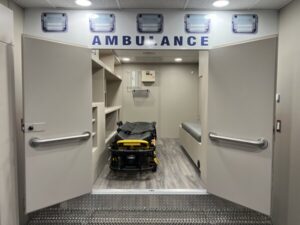 These mobile classrooms feature the latest medical equipment for emergencies, trauma situations, and everyday patient care. They can simulate ambulances, emergency rooms, trauma centers, and hospital patient care settings. Mobile sim labs use computerized high-fidelity patient simulator manikins that can breathe, respond to treatment, and even talk. The students use actual medical and rescue equipment, including:
A mobile SIM lab will prepare students for a wide variety of disciplines, including:
Mobile sim labs provide students with experience across a wide variety of standardized scenarios and practices for multiple procedures, delivering the highest-quality experiential learning to prepare them for the front lines. They also strengthen their interprofessional education, which is key in healthcare, particularly in a mobile setting.
A recent online survey of medical students explored their attitudes toward interprofessional education (IPE) and examined whether previous exposure to IPE shaped their appreciation for collaborative practice. Interestingly, the findings revealed that regardless of prior experience, students overwhelmingly recognized the value of interprofessional learning and teamwork.
Students expressed a strong interest in joining IPE courses alongside peers from nursing, pharmacy, public health, and other disciplines. At the same time, they identified several challenges that can limit participation, most notably time constraints, scheduling conflicts, and communication barriers.
Despite these hurdles, medical students embraced the concept of learning with and from other healthcare professionals. They highlighted clinical case studies and simulations as particularly effective means of bringing multiple disciplines together in meaningful, practice-focused ways.
Overall, the positive attitudes and perceptions captured in this survey underscore a clear takeaway: integrating interprofessional education into medical school curricula isn’t just beneficial, it’s essential. Doing so can strengthen collaborative skills and better prepare students to become effective, team-based healthcare providers.
Due to the growing need to implement these and other best practices to improve patient safety and healthcare outcomes, there are even educational curricula for simulation training instructors to obtain associate, bachelor’s, master’s, or postdoctoral degrees.
Simulation training is often a preferred learning method among students and is a key component of training to work in a mobile clinic. Mobile simulation labs can bring high-quality, hands-on training directly to students on campus or in the field, allowing them to practice complex clinical decision-making and teamwork in a safe, controlled environment before working with real patients. This approach effectively bridges the gap between classroom instruction and real-life application.
Because mobile simulation labs offer standardized, repeatable scenarios, trainees build competence and confidence before entering real-world settings. This strengthens clinical readiness and supports a culture of quality and safety.
Learn more at: Revolutionizing Medical Training