



Accessibility is often a critical component of mobile healthcare, not just a design choice. For individuals with disabilities, mobile clinics can offer the same access to essential health services as traditional, fixed clinics. Whenever possible, ADA designs should be incorporated into your plans to ensure patients can enter, move around, and receive care comfortably and autonomously within the vehicle. This is particularly important for individuals with disabilities as well as aging populations, providing stability and ease of access.
Under the Americans with Disabilities Act (ADA), all healthcare buildings must ensure access for individuals with disabilities. Compliance isn’t optional; it’s the law. However, that does not apply to mobile health clinics.
While California and some other states have stricter requirements for mobile clinics to comply more closely with ADA requirements, many manufacturers try to thread the needle to “appear” compliant. For instance, a 29-foot, two-exam vehicle cannot provide the space needed to meet full ADA standards. They may profess ADA compliance by installing a “Transformers”-style restroom, disassembling and shifting exam room walls and doors to create a makeshift ADA restroom. However, this makes accessing the ADA restroom particularly challenging for patients and their healthcare professionals. And it obviously does not align with the spirit of the ADA, which seeks full autonomy for individuals with mobility issues. With these manufacturers’ designs, if a wheelchair patient needs to use the restroom, healthcare staff have to take minutes to latch and maneuver multiple doors and wall partitions to create the ADA restroom space before a wheelchair patient in need can even use the restroom. Once the patient is done using the restroom, that person must navigate alone in the bathroom, struggling with non-standard doors and latching mechanisms to exit. It is an untenable space in the best of circumstances and prevents the patient from being truly autonomous.
Regardless of the lack of a legal mandate, an ADA-accessible design for a mobile health clinic reflects a deeper commitment to your clients. From elderly patients with less mobility to those requiring wheelchair access, the services of your mobile health clinic should be available to everyone in your community.
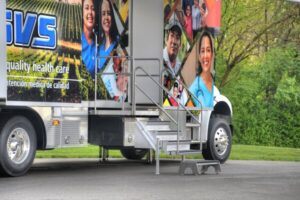
Just having a wheelchair lift doesn’t make a vehicle ADA accessible. While eligibility for certain grants requires ADA accessibility, many manufacturers install a wheelchair lift, but do not account for the space needed to turn, enter and exit a room, or use a restroom.
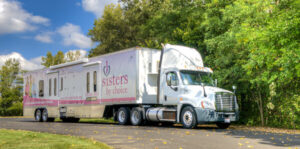
For example, larger vehicles with slide-outs offer flexibility and additional space. And trucks with tandem axles and four slide-outs are sized to accommodate medical, dental, or a combination of both in a single mobile clinic. More space also adds future flexibility into the floor plan. As the funding focus for your program changes, larger vehicles are easier to change equipment out and keep your program serving your community most effectively.
Slide-out walls are great for providing extra space. However, they also need a strong frame to hold the slide-outs, strength in the floor and walls to remain square with frequent extending and retracting, and robust landing gear to support the cantilevered weight of the rooms when they are deployed. Additionally, the weight of the slide-out with power exam tables or dental chairs, when stored in the vehicle, can wear out a lightweight frame and body, maneuvering on rough roads, hitting potholes, and twisting over ramps, turns, and other adverse conditions.
A purpose-built clinic, engineered with the correct dimensions and thoughtfully designed, accommodates a wide range of physical needs with additional benefits:
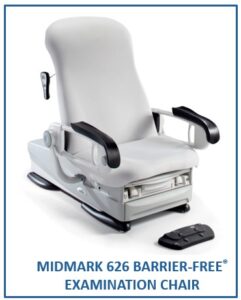 Fully Accessible Exam Tables and Seat Heights make it easier for patients with mobility challenges to transfer independently. Some mobile clinic manufacturers incorporate the Midmark 626 Barrier-Free® Examination Chair into their design. This chair is an ideal solution for accessible patient care, featuring a low seat height of 15.5 inches, exceeding the U.S. Access Board requirement of 17 to 19 inches. It also features an adjustable transfer surface to raise the chair to an ergonomic height and optional support rails for patient stability, reducing the risk of injury.
These design elements not only follow ADA guidelines but also create a welcoming and functional environment for every patient.
Some of these details may seem minor, but they create a significant impact, transforming your mobile unit into a professional, patient-friendly environment that functions like a traditional healthcare facility.
ADA spaces in mobile health clinics are more than just equipment. Thoughtful floor plan design and space allow multiple people to comfortably be in the exam room with the patient, such as a doctor, nurse, and caregiver. ADA spaces also support seamless workflows from intake to lab work and create extra space for private consultations. The result is a mobile clinic that offers an open environment, is efficient, and truly accessible, enabling you to deliver care with credibility and compassion, wherever it’s needed most.
LifeLine Mobile units are designed with patient comfort and staff efficiency in mind. Features such as functional desk space, customized cabinetry, slide-out walls for additional maneuverability and dedicated space for medical equipment help create a comfortable, accessible workspace. Units can also accommodate equipment such as the Midmark 626 Barrier-Free Examination Chair to support patient accessibility.
LifeLine Mobile units are designed to support efficient workflows through ADA-accessible layouts, additional workspace and thoughtful equipment placement. Each unit is customized to accommodate medical equipment while providing enough room for healthcare staff to move comfortably and deliver quality patient care.
Yes, LifeLine Mobile units can be customized to meet the unique healthcare needs of different communities. From specialized medical equipment to accessible layouts and tailored workspaces, each unit is designed to support the services being provided and help healthcare organizations deliver care where it’s needed most.
Like traditional healthcare facilities, LifeLine Mobile clinics support infection control through proper airflow, routine sterilization of medical tools and equipment and the use of appropriate personal protective equipment (PPE). Following established infection control protocols helps maintain a safe environment for both patients and healthcare staff.